
Essex Steel: Four Iconic Structures
10 August 2026
With its close proximity to the nation’s capital, Essex has long been a testing ground for ambitious steel and iron engineering projects. The county is a natural corridor for major infrastructure (road crossings, ports, and airports) that needed to be built at a scale requiring structural steel, rather than traditional materials.
Here we take a look at four of Essex's most iconic steel structures.
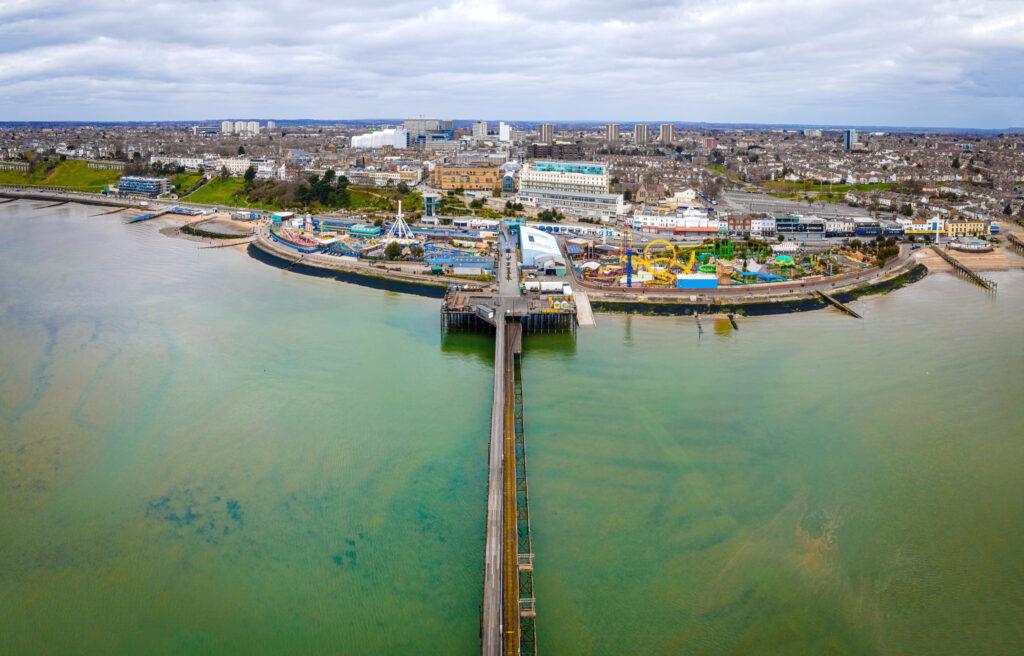
1: Southend Pier
Stretching 1.34 miles into the Thames Estuary, Southend Pier is the world's longest pleasure pier and a defining feature of the Essex coastline. The timber pier was replaced by an iron pier that opened to the public in August 1889, and it has been repaired and reinforced many times since, including after fires in 1976, 1995, and 2005.
The original iron pier was designed by James Brunless and constructed in 1889, then extended in 1898 and again in 1929. Modern conservation work has involved refurbishing wrought iron beams by replacing plates, boring out corroded bolt holes, and galvanising the steelwork to protect it against the harsh coastal environment. It remains a Grade II listed structure and a rare example of large-scale Victorian ironwork still in daily public use.
2: Queen Elizabeth II Bridge, Dartford Crossing
Linking Thurrock in Essex to Dartford in Kent, this cable-stayed bridge is one of the most heavily used estuarial crossings in the UK. Completed in 1991, it was designed by Dr. Ing Hellmut Homberg and Partner and Kvaerner Technology Limited, and built by a joint venture between Kvaerner Construction Limited and Cleveland Bridge & Engineering Company.
Its central span stretches 450 metres and sits 65 metres above the Thames, tall enough for ocean-going cruise liners to pass beneath, while 84-metre steel pylons rise above 53-metre concrete piers to give the bridge a total height of 137 metres.
When it opened, it was Europe's largest cable-supported bridge, and it remains a striking piece of steel engineering on the Essex skyline.
3: Stansted Airport Terminal
Designed by Foster + Partners and opened in 1991, Stansted's terminal is celebrated for turning conventional airport design upside down. The roof is held up by 36 “trees,” each with a trunk made of four 12-metre-high steel columns arranged at the corners of a three-metre square, with all building services routed underground rather than through the roof.
A complex system of steel cables and cross-bracing provides lateral stability to the floating steel and glass roof. The elegant lattice structure lets in natural light across the concourse and has been widely praised as a model of high-tech architecture, influencing airport design worldwide.
4: Tilbury2 Port Terminal
Built on the site of the former Tilbury power station, Tilbury2 is a major expansion of the Port of Tilbury, said to be the UK’s fastest growing port. The terrestrial works included a fixed structural steel bridge to the linkspan, alongside highway works and the relocation of the existing railhead, while the marine contract involved a floating pontoon and articulated bridge within the tidal estuary.
The four-span Fort Road Bridge, officially opened in July 2020, was positioned onto pile-supported abutments and three intermediate reinforced concrete piers, forming a key part of this “Nationally Significant Infrastructure Project” that has boosted freight and logistics capacity for the region.
Order Steel for Your Essex Project Online Today
If you’re looking for steel beams in Essex, Buy A Beam provides a fast and simple way to order structural steel online. Our platform allows builders, contractors and DIY customers to quickly source the steel sections they need for construction and renovation projects across Essex.
Our customers across Essex regularly order products such as Steel Beams, Steel Channels, Steel Angles, and Flat Bars for a wide range of building and fabrication projects.